Safe deposit boxes occupy a peculiar space in the precious metals storage hierarchy—simultaneously among the most trusted and most misunderstood options available. For generations, investors have locked their gold coins, silver bars, and irreplaceable documents behind the heavy steel doors of bank vaults, drawing comfort from the imposing security that surrounds them. Yet the reality of what banks actually guarantee—and more importantly, what they don’t—reveals critical gaps between perception and protection that every precious metals holder must understand.
This comprehensive analysis examines the mechanics, risks, legal framework, and practical considerations of using bank safe deposit boxes for storing physical gold and silver. While these boxes serve legitimate purposes within a diversified storage strategy, their limitations require informed decision-making rather than blind trust in the word “safe.”
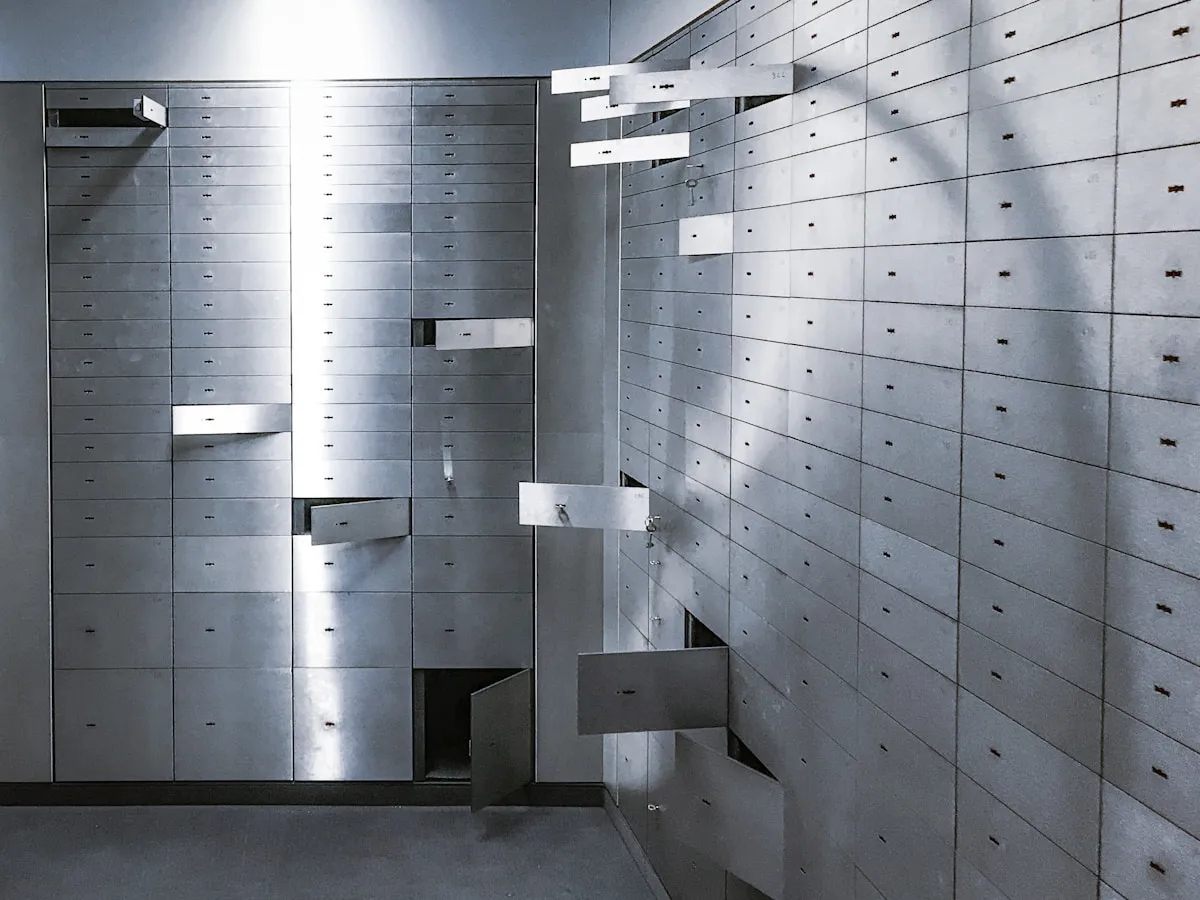
The enduring appeal of bank vault storage
The attraction of bank safe deposit boxes for precious metals storage rests on several tangible advantages that have drawn customers for over a century. Annual rental costs typically range from $35 to $300 depending on box size—a fraction of what professional vault storage charges for the same metal. A 5x10 inch box capable of holding 50-100 ounces of gold or several hundred ounces of silver might cost only $100-$200 annually at most institutions.
Beyond cost, bank boxes eliminate the anxiety of home storage. Rather than worrying about burglary, fire, or discovery by contractors and visitors, customers can lock valuables inside massive vaults featuring 18-inch steel doors, time-delay mechanisms, and 24-hour monitoring systems. The psychological comfort of knowing your metals rest inside a fortress-like structure shouldn’t be underestimated—it’s the reason generations of families have passed down the same rented boxes from parents to children.
Geographic diversification provides another genuine benefit. Storing metals at a bank branch miles from your residence protects against localized disasters. When a home fire destroys everything inside, metals held in a separate bank location survive intact. This “don’t keep all your eggs in one basket” logic represents sound planning, even if bank boxes shouldn’t serve as the primary basket.
Access during banking hours proves sufficient for most holders who buy and hold physical metals for years rather than trading frequently. The typical investor who adds a few ounces annually finds the 9-to-5 Monday-through-Friday schedule perfectly adequate. Banks also provide private viewing rooms where customers can examine, add, or remove items without observation—a level of discretion that appeals to those who prefer keeping their holdings confidential.
Fire and flood protection exceed what most home safes can match. Bank vaults typically sit above ground level in buildings with advanced suppression systems, and the vault structures themselves carry fire-resistance ratings measured in hours rather than minutes. The physical security infrastructure banks already maintain for their cash and records extends automatically to safe deposit customers at no additional charge.
How safe deposit boxes actually work
Understanding the mechanical and legal framework governing safe deposit boxes reveals important distinctions from what many customers assume. The fundamental concept involves a bailment for hire—a legal arrangement where the bank provides secure space while customers retain full ownership and responsibility for contents.
The dual-key access system
Modern safe deposit boxes employ a two-key security mechanism requiring both the bank’s guard key and the customer’s personal key to open. When customers arrive to access their box, they must present valid government-issued identification and sign an access log that’s compared against their signature card on file. A bank employee then escorts the customer to the vault area, inserts the guard key, and waits for the customer to insert their key. Neither key alone can open the box.
After opening, the employee typically withdraws while the customer carries the box to a private viewing booth. What happens in that booth remains unobserved—bank employees don’t monitor contents during viewing sessions, and no records are made of what customers deposit or remove. This privacy extends only to the viewing process itself; the bank maintains detailed logs of who accessed what box and when, information that becomes relevant in legal proceedings.
Size options and what they hold
Bank safe deposit boxes come in standardized sizes measured by depth, width, and length. The depth dimension (into the vault) typically remains constant at 22-24 inches while width and height vary. Understanding capacity helps customers choose appropriate boxes for their precious metals holdings:
3x5 inches (small): These entry-level boxes rent for $35-$80 annually and accommodate modest holdings—perhaps 10-20 gold coins, a small stack of silver rounds, important documents, and jewelry. Depth provides reasonable capacity despite the compact footprint.
5x5 inches (medium): At $50-$125 annually, medium boxes offer enough room for several hundred ounces of silver in coins or small bars, along with gold holdings worth $10,000-$25,000 depending on form factor. Most casual collectors find this size adequate.
5x10 inches (large): These $100-$200/year boxes serve serious precious metals investors well. Expect capacity for 50-100 ounces of gold plus accompanying silver, documentation, and backup items. The size handles multi-year accumulation for most individual investors.
10x10 inches (extra large): Premium boxes at $150-$350 annually accommodate larger collections, estate holdings, or investors who store both metals and significant documentation. Availability of this size has become limited as banks reduce safe deposit programs.
What the rental contract actually says
The contract customers sign when renting a safe deposit box contains language that would alarm most people if they read it carefully. Bank of America’s current agreement states plainly: “The Bank assumes no liability for damage to contents as a result of fire, explosion, heat, smoke, water, flooding or plumbing issues and building damage, or other events beyond the Bank’s control.” Wells Fargo explicitly notes: “The contents of your Box are not insured by Wells Fargo or the Federal Deposit Insurance Corporation.”
These disclaimers aren’t buried in fine print—they’re fundamental features of the rental relationship. Banks provide secure space, not secure contents. The distinction matters enormously when customers assume their metals enjoy the same protection as their checking account balances.
Standard contract provisions across major banks include:
- Maximum liability capped at $10,000 (Wells Fargo), $25,000 (Chase), or 10 times annual rent (Bank of America)—regardless of actual losses
- Force majeure clauses exempting banks from any liability for natural disasters, riots, power failures, pandemics, or “events beyond control”
- Requirements that customers must prove both that property was in the box AND that the bank’s negligence caused its loss—an extremely difficult evidentiary burden
- Statements explicitly disclaiming bailment relationships, though courts have generally found bailment principles apply regardless
Bank of America goes further, stating: “Renter agrees that the Bank shall not be liable for any loss sustained by Renter, unless such loss is caused by some specific and clearly proven willful act of the Bank.” The phrase “clearly proven willful act” sets an extraordinarily high bar for recovery.
⚠ Warning
Read your safe deposit box rental contract carefully. Most banks cap liability at $500-$25,000 regardless of actual losses and disclaim responsibility for fire, flood, and events “beyond the bank’s control.”
The insurance gap that catches most customers by surprise
Perhaps no aspect of safe deposit boxes creates more dangerous misunderstanding than insurance coverage—or rather, the near-complete absence of it. The perception that valuables locked in a bank vault enjoy institutional protection leads many customers to skip arranging their own insurance, a decision that can prove financially devastating.
What FDIC coverage doesn’t include
The Federal Deposit Insurance Corporation insures deposit accounts—checking, savings, money market accounts, and certificates of deposit—up to $250,000 per depositor per institution. This protection covers the balance if a bank fails. Safe deposit box contents fall entirely outside this framework.
As the FDIC explicitly states: “A safe deposit box is not a deposit account. It is storage space provided by the bank, so the contents, including cash, checks or other valuables, are not insured by FDIC deposit insurance if damaged or stolen.” Luke W. Reynolds, Chief of the FDIC’s Community Outreach Section, has confirmed: “Cash that’s not in a deposit account isn’t protected by FDIC insurance.”
This distinction matters because FDIC stickers on bank windows and deposit account agreements create a general impression of government-backed safety that doesn’t extend to safe deposit boxes. A bank failure that triggers FDIC intervention to protect depositors does nothing for safe deposit customers whose boxes happen to be in that same failed institution.
Banks don’t insure your contents either
Beyond the FDIC coverage gap, banks themselves maintain no insurance on customer box contents. The vault structure is insured as bank property, but whatever customers place inside carries no protection from the bank. Standard contract language makes this explicit: “The contents of your safe deposit box are not protected against loss under any insurance maintained by the bank.”
This means losses from any cause—theft (even if bank security fails), fire, flood, water damage from sprinkler systems, bank employee misconduct, drilling errors, or mysterious disappearance—leave customers with no recourse through the bank’s insurance policies. The bank has externalized all risk to the customer while accepting payment for providing “secure” storage space.
★ Important
Safe deposit box contents are NOT covered by FDIC insurance, and banks carry no insurance on your contents. You must arrange your own coverage through a homeowner’s endorsement or specialty insurer like SDBIC.
Arranging your own coverage
Given the insurance void, precious metals holders must secure their own protection through one of several channels:
Homeowner’s insurance endorsements can extend to cover off-premises valuables including safe deposit box contents. However, standard policies impose severe limitations on precious metals. Typical unscheduled coverage for gold bullion runs only $200-$500 total; jewelry sublimits cap at $1,000-$2,500. Adequate coverage requires adding a scheduled personal property endorsement, which means:
- Listing items individually with appraised values
- Providing receipts, photographs, and professional appraisals for higher-value pieces
- Paying premiums of approximately 1-2% of insured value annually
- Updating appraisals periodically (typically every 2-3 years)
For $50,000 in precious metals, expect homeowner’s endorsement premiums of $500-$1,000 annually plus appraisal costs.
Specialty insurers offer more cost-effective alternatives specifically designed for safe deposit box contents. The Safe Deposit Box Insurance Company (SDBIC), underwritten by AXA Art Insurance (A.M. Best “A” rated), provides blanket coverage from $5,000 to $500,000+ with several notable advantages:
- No appraisals required at purchase—documentation needed only for claims
- No disclosure of contents to obtain coverage
- Premiums around 0.5% of value—roughly $250/year for $50,000 coverage
- Coverage for precious metals, cash, documents, jewelry
- Protection against fire, flood, earthquake, hurricane, tornado, and even bank wrongful confiscation
This pricing makes specialty insurance significantly more economical than homeowner’s endorsements. The same $50,000 in metals costs approximately half as much to insure through SDBIC compared to a homeowner’s rider, without the hassle of appraisals and inventories.
✓ Pro Tip
SDBIC provides blanket safe deposit box coverage at approximately 0.5% of value annually with no appraisals required and no content disclosure needed. Enrollment takes about five minutes online at safedepositboxinsurance.com.
Hugh Wood Inc., a specialty broker with over 30 years in collectibles and precious metals insurance, provides custom coverage through Lloyd’s of London markets. Their numismatic insurance partnerships with the American Numismatic Association make them particularly suitable for coin collectors, while bullion investors benefit from their flexible home/vault split coverage options.
"Banks provide secure space, not secure contents. The distinction matters enormously when customers assume their metals enjoy the same protection as their checking account balances."— Standard bank safe deposit box contract analysis
Historical precedents of access denial
The fundamental counterparty risk of safe deposit boxes—that access depends on the bank remaining open and willing to provide it—has manifested repeatedly across different eras and countries. Understanding these precedents helps investors calibrate how much reliance to place on bank-based storage.
Executive Order 6102 and the 1933 gold confiscation
The most frequently cited precedent for government seizure of privately held gold occurred on April 5, 1933, when President Franklin Roosevelt signed Executive Order 6102 requiring citizens to surrender gold coin, bullion, and gold certificates to the Federal Reserve. Penalties included fines up to $10,000 (equivalent to approximately $243,000 today) and imprisonment up to 10 years.
However, the popular narrative of FBI agents marching into bank vaults to systematically search safe deposit boxes is largely mythological. A widely circulated hoax document falsely claimed Roosevelt ordered all safe deposit boxes sealed and searched by the IRS. In reality, no evidence supports systematic box searches under Executive Order 6102. The government lacked resources for such comprehensive enforcement, and many citizens who kept quiet retained undeclared gold undiscovered.
The Frederick Barber Campbell case represents the most significant documented enforcement action. Campbell, a Manhattan attorney, deposited 27 bars of gold bullion (over 5,000 troy ounces) at Chase National Bank between October 1932 and January 1933. When he demanded return of his gold in September 1933, Chase refused, and a federal grand jury indicted Campbell for failing to register his holdings.
In a surprising outcome, Federal Judge John M. Woolsey ruled the prosecution invalid on technical grounds—the Executive Order was signed by the President rather than the Secretary of the Treasury as legally required. While Campbell was effectively acquitted, he never recovered his gold; subsequent executive orders and the Gold Reserve Act of 1934 closed the technical loophole.
The precedent that matters isn’t mass confiscation—which didn’t occur—but rather that banks cooperated fully with government directives. When federal authorities identified large holdings and made specific requests, banks complied. Anyone storing significant gold in a bank box had effectively placed their metals within easy government reach.
ℹ Note
The 1933 gold confiscation did not involve mass raids on safe deposit boxes, contrary to popular myth. However, banks did cooperate fully with federal directives when authorities made specific requests about individual holdings.
Cyprus 2013: when bank holidays freeze everything
The Cyprus banking crisis demonstrated how modern capital controls render safe deposit boxes inaccessible regardless of what’s inside them. On March 15, 2013, Cyprus Popular Bank and Bank of Cyprus abruptly closed as the Eurogroup demanded a deposit levy as part of bailout negotiations. Banks remained shuttered for approximately 12 days (March 16-28), during which no customer could access safe deposit boxes for any purpose.
When banks finally reopened, draconian capital controls governed all transactions:
- Cash withdrawals limited to €300 per day per depositor per institution
- Transactions over €5,000 required Central Bank of Cyprus approval
- Maximum €3,000 cash permitted per trip leaving the country
- Armed guards stationed at bank branches
These controls restricted access to safe deposit boxes even after branches reopened, as banks prioritized controlling capital outflows over routine box access. Domestic capital controls persisted until May 2014, with full removal of all restrictions not occurring until April 6, 2015—more than two years after the crisis began.
The Cypriot crisis also introduced “bail-in” mechanics to the developed world. Uninsured deposits (above €100,000) at Bank of Cyprus suffered a 47.5% haircut, with seized funds converted to bank equity. While safe deposit box contents weren’t confiscated, the practical reality of months without access rendered the theoretical ownership moot for anyone needing those assets during the crisis.
Greece 2015: explicit box access denial
Greece’s 2015 banking crisis provided the clearest modern documentation of safe deposit box access restrictions. On June 28, 2015, the Greek government announced capital controls and a bank holiday that lasted approximately 20 days through July 18, 2015.
Deputy Finance Minister Nadia Valavani confirmed publicly on Greek television that citizens could not withdraw cash or contents from safe deposit boxes while capital controls remained in effect. This wasn’t incidental—reportedly, contingency planning included the possibility of seizing euro cash from safe deposit boxes if the European Central Bank ended emergency liquidity assistance. The government could theoretically compensate box holders with increasingly inaccessible bank deposits while redistributing the physical cash to ATMs.
Initial controls limited ATM withdrawals to just €60 per day. Gradual relaxations occurred over the following years, but complete removal of all capital controls didn’t happen until September 1, 2019—more than four years after imposition. Throughout this period, box access remained constrained by the broader banking restrictions.
Argentina’s corralito and the limits of dollar denominations
Argentina’s 2001-2002 economic collapse illustrated how currency controls affect all bank services simultaneously. On December 1, 2001, Economy Minister Domingo Cavallo announced the “corralito” (little corral) via Decree 1570/2001, limiting cash withdrawals to 250 Argentine pesos per week—equivalent to approximately $250 under the then-prevailing 1:1 exchange rate peg.
Within weeks, President de la Rúa resigned amid riots, and Argentina cycled through five presidents in ten days. The January 2002 “pesification” forcibly converted dollar-denominated deposits to pesos at an official rate of 1.40 pesos per dollar, even as the market exchange rate spiked to 4 pesos per dollar. Depositors effectively lost 50-75% of their dollar value overnight.
While documentation of specific safe deposit box restrictions during this period remains limited, the extended bank holidays and chaotic conditions would have prevented normal access. The broader lesson applies: when banking systems experience systemic stress, all bank services become unreliable, not just deposit accounts.
U.S. bank failures: IndyMac and beyond
The 2008 failure of IndyMac Bank tested American procedures for safe deposit box access during FDIC takeovers. When the Office of Thrift Supervision closed IndyMac on Friday, July 11, 2008, at 3 PM Pacific Time, safe deposit boxes became inaccessible for the weekend. The FDIC reopened the successor institution (IndyMac Federal Bank) on Monday, July 14, and access resumed.
For most customers, this meant only a two-day interruption—a weekend. However, the FDIC has no obligation to maintain safe deposit box services, and acquiring banks may terminate box rentals with 30-60 day notice. During the 2008-2013 period, nearly 500 banks failed in the United States. While the FDIC’s standard approach minimizes disruption through purchase and assumption transactions, the underlying fragility remains.
Natural disasters and physical access destruction
Hurricane Katrina in 2005 demonstrated that bank vaults, while highly secure, are not invulnerable to catastrophic natural events. Whitney National Bank in New Orleans saw safe deposit boxes submerged for approximately three weeks. When waters finally receded and access became possible, bank employees returned contents to customers in plastic bins—paper documents destroyed, but metals generally survived.
One documented case involved family bearer bonds worth $250,000 stored in a safe deposit box that sat underwater for weeks. The deteriorated bonds remained in the owner’s attic for 17 years before Louisiana’s Unclaimed Property Program restored their value—but only after the family navigated bureaucratic processes to prove ownership.
Beyond flooding, the California wildfires have repeatedly demonstrated access interruption risk. The January 2025 Eaton Fire destroyed a Bank of America branch on Lake Avenue in Altadena, leaving safe deposit boxes inaccessible for weeks while structural engineers assessed the site. As of late January 2025—nearly four weeks after the fire—customers still awaited word on whether their box contents survived and when they could retrieve them.
The bank explained it must stabilize the structure before boxes can be safely removed and relocated. One customer with irreplaceable film footage in her box faced weeks of uncertainty about whether decades of work survived.
Privacy considerations and government access
The privacy offered by safe deposit boxes, while meaningful, operates within defined legal boundaries that customers should understand. Banks know you have a box but don’t know what’s inside—a legitimate privacy benefit. However, this privacy isn’t absolute, and multiple legal processes can pierce it.
What banks track and report
Banks maintain detailed access logs documenting every entry to safe deposit box areas. These records show who accessed which box on what date and time. Large or unusually frequent visits might draw attention from bank compliance personnel, though no specific reporting requirements attach to box access patterns.
Bank employees witness customers entering and exiting with bags, cases, or packages—they observe that something is being deposited or removed even without knowing the specific contents. This creates a record of activity that could become relevant in investigations.
There is no automatic reporting of safe deposit box rentals to the IRS or other agencies. However, if customers pay rental fees in cash exceeding $10,000, banks must file Currency Transaction Reports (CTRs). Suspicious activity around safe deposit boxes—unusual access patterns, apparent structuring of deposits, or activity suggesting concealment—can trigger Suspicious Activity Reports (SARs). Banks enjoy safe harbor protection for SAR filings and cannot notify customers that a report was made.
Legal processes that compel access
Multiple government authorities can obtain access to safe deposit boxes through appropriate legal processes:
IRS tax investigations proceed through the levy process. The IRS serves Form 668-A (Notice of Levy) on the bank, which must hold box contents for 21 days before seizure occurs. If the taxpayer refuses to cooperate, the IRS can seek a Writ of Entry through the courts. However, banks typically won’t open boxes without customer consent or a court order, providing some procedural protection.
Law enforcement requires warrants based on probable cause to access box contents. The Fourth Amendment demands that search warrants specifically describe the location to be searched and items to be seized. Once a valid warrant issues, banks have no legal basis to refuse access.
Divorce proceedings frequently involve safe deposit box discovery. Courts can order joint access, complete inventories, and asset turnover. California’s Automatic Temporary Restraining Orders (ATROs) that trigger upon divorce filing automatically prevent either spouse from transferring items from safe deposit boxes. Hiding assets in a box during divorce proceedings constitutes illegal conduct that courts will punish.
Estate administration requires that executors eventually gain access to deceased individuals’ boxes. Some states seal boxes upon death until estate procedures complete, which can delay administration by weeks or months. Probate court orders may be required before banks permit executor access.
The 2021 US Private Vaults raid: a cautionary precedent
While technically involving a private vault rather than bank safe deposit boxes, the March 2021 FBI raid on US Private Vaults in Beverly Hills provides sobering insight into government willingness to push legal boundaries.
FBI agents executed a warrant on March 22, 2021, targeting the company for suspected money laundering. The warrant authorized seizure of US Private Vaults’ business property and permitted agents to “inspect the contents of the boxes in an effort to identify their owners…so that they can claim their property.” Critically, the warrant explicitly prohibited criminal search or seizure of individual box contents.
Despite this limitation, FBI agents opened every one of approximately 1,400 boxes, photographed contents, ran cash over $5,000 past drug-sniffing dogs, and filed administrative forfeiture claims totaling over $86 million. Internal depositions later revealed the FBI had planned months before the raid to forfeit any box containing property worth more than $5,000—a plan not disclosed to the magistrate who approved the warrant.
In January 2024, a three-judge panel of the Ninth Circuit Court of Appeals unanimously ruled the FBI violated Fourth Amendment rights. The court compared FBI actions to the “abuses of power” and “limitless searches” that originally led to the Fourth Amendment’s adoption, drawing explicit parallels to British colonial-era writs of assistance. The court ordered the FBI to destroy all inventory records and database information obtained from the raid.
Despite seizing over $86 million, the U.S. Attorney’s Office confirmed it has “not filed any other criminal charges” against individual box holders beyond the company itself. Many innocent customers spent years in litigation to recover their property. Some items remain missing, with ongoing lawsuits over FBI failure to return all seized contents.
This case demonstrates that government agencies may exceed warrant authority, that legal challenges take years to resolve, and that even eventual vindication doesn’t guarantee complete property recovery.
When banks drill the wrong box
Bank errors affecting safe deposit boxes occur more frequently than most customers realize, and the consequences can prove catastrophic for those affected. The absence of federal regulation governing safe deposit boxes creates a legal gray zone where customers have limited recourse.
The Philip Poniz case: $10 million lost through bank mistake
The most significant documented drilling error case involves Philip Poniz, an internationally known watchmaker and horologist who stored 92 rare watches plus gold coins in Box 105 at a Wells Fargo branch in New Jersey. In April 2014, Wells Fargo attempted to evict another customer for non-payment and drilled the wrong box by mistake.
The error occurred because the Highland Park branch contained two boxes numbered “105” after consolidating boxes from multiple merged branches. Employees mixed them up. When Wells Fargo eventually returned items from storage in North Carolina, seven watches were missing, along with gold coins and other items valued at nearly $1 million. Total estimated losses exceed $10 million—potentially the largest safe-deposit-box loss in American history.
Wells Fargo admitted in court that employees “mistakenly drilled into and terminated the wrong box.” Yet the bank fought for years to move the case to arbitration, and as of the latest reports, Poniz has received no restitution despite the admitted error. Standard Wells Fargo contracts cap liability at just $500, though courts may not enforce such limitations where the bank’s own procedures were violated.
Systemic problems at major banks
The Poniz case isn’t isolated. Multiple additional Wells Fargo incidents have been documented:
A West Allis, Wisconsin customer had her box drilled by mistake, with the contents—including $4,000—given to the wrong person. The recipient was initially told to keep the money; she only returned it after seeing a news report about the error.
In Roanoke, Virginia, an heir named Sally Gravely arrived to access her deceased sister’s safe deposit box only to find it had already been drilled and emptied. Wells Fargo had no records explaining when or who performed the drilling. Adding insult to injury, the bank later sent bills for rental of the empty box.
At the same Virginia branch, a son discovered his deceased mother’s box already drilled and physically missing. Again, Wells Fargo offered no explanation but later sought past-due rental payments.
In Los Angeles, sisters Jill Beber and Dana Lipin found their grandparents’ heirlooms—items brought from Germany when the family escaped the Nazis—missing from their box. Someone else’s belongings had been placed inside. Another customer at the same institution reported a mid-six-figure jewelry collection missing.
Bank of America’s branch closure disaster
When Bank of America closed a Universal City, California branch in June 2013, the resulting safe deposit box debacle led to a $4.5 million jury verdict that later exposed how banks treat drilling procedures.
Lianna Saribekyan and her husband had rented a large box in September 2012, paying $246 annually, to store jewelry, cash, gemstones, and family heirlooms. When the branch closed, Bank of America drilled open all approximately 750 boxes. Over one-third (more than 250 boxes) had to be forcibly drilled, and contents from over 10% were inventoried without customers present.
The procedural violations proved damning. Bank of America’s own policies required drilling one box at a time with immediate inventory. Instead, employees drilled multiple boxes simultaneously, placed contents in bags, removed or discarded tracking serial numbers, and left bags unsecured in the vault for three days while seven different people accessed the vault area. The bank’s before-and-after inventories showed discrepancies proving items went missing.
The 2017 jury found Bank of America liable for breach of contract and theft, concluding that employees acted with “malice, oppression or fraud.” The $4.5 million verdict ($2.5 million compensatory plus $2 million punitive) seemed to vindicate Saribekyan. However, the trial judge subsequently enforced the contract’s liability limitation—10 times annual rent, or just $2,460—and reduced punitive damages to $150,000. Total recovery collapsed to approximately $152,460.
On appeal, a California appellate court found multiple errors and ordered a new trial, ruling the liability limitation should not apply where the bank violated its own procedures. The case continues, illustrating how even clear-cut wrongdoing leads to years of litigation rather than prompt compensation.
Insurance solutions for safe deposit box contents
Given the absence of bank-provided protection and the real risk of losses, arranging adequate insurance represents an essential step for any precious metals holder using bank boxes. Several options exist at varying cost and complexity levels.
Adding coverage through homeowner’s policies
The most familiar approach involves adding a scheduled personal property endorsement (sometimes called a personal articles floater) to existing homeowner’s or renter’s insurance. This creates itemized coverage for specific valuables wherever they’re stored, including safe deposit boxes.
Standard homeowner’s policies without endorsements provide minimal precious metals coverage—typically only $200-$500 total for bullion and coins, with jewelry sublimits of $1,000-$2,500. These amounts cover almost nothing for serious collectors.
Scheduled endorsements require listing each item with its appraised value. For precious metals, this means professional appraisals (costing $50-$150 or more per item) and detailed documentation including receipts, photographs, and descriptions. Premiums run approximately 1-2% of insured value annually—so $50,000 in scheduled metals costs roughly $500-$1,000 per year in added premium.
Benefits of this approach include coverage for accidental loss and “mysterious disappearance,” worldwide protection, zero or low deductibles, and integration with existing insurance relationships. Drawbacks include appraisal hassles, the need for regular updates, potentially higher premiums than specialty alternatives, and possible policy exclusions for certain perils.
Specialty insurers offer better value
The Safe Deposit Box Insurance Company (SDBIC), underwritten by AXA Art Insurance with an A.M. Best “A” rating, provides purpose-built coverage specifically for safe deposit box contents. This specialty approach offers significant advantages:
No appraisals required at purchase—customers select coverage amounts without itemizing contents or proving current values. Documentation becomes necessary only at claim time.
No content disclosure—customers don’t reveal what’s in their boxes to obtain coverage, maintaining privacy.
Coverage amounts from $5,000 to $500,000+, with higher limits available by contacting the company directly.
Comprehensive peril coverage including fire, flood, robbery, burglary, hurricane, tornado, earthquake, mudslide, volcanic activity, and even bank wrongful confiscation.
Premiums around 0.5% of value annually—roughly $250 per year for $50,000 in coverage, or approximately half what comparable homeowner’s endorsements cost.
No deductibles apply to claims.
Fast enrollment—coverage can be arranged online in minutes.
For $100,000 in precious metals, SDBIC coverage runs approximately $500 annually compared to $1,000-$2,000 for typical homeowner’s endorsements. The math strongly favors specialty coverage for anyone with substantial safe deposit box holdings.
Hugh Wood Inc. (now part of Risk Strategies following a March 2024 acquisition) serves collectors and investors with custom insurance through Lloyd’s of London markets. Their 30+ years specializing in numismatic and precious metals insurance makes them particularly suitable for significant collections. They offer home/vault split coverage, transit protection for personally accompanied metals, and access to international markets for complex coverage needs. They’ve handled claims exceeding $4 million with professional efficiency.
Several banks have partnered with SDBIC to offer insurance directly to customers, including First Mid Bank & Trust, Truist Bank, and First Citizens National Bank. Customers at these institutions can often arrange coverage through their bank relationship.
Coverage limits and documentation requirements
Most insurers cap safe deposit box coverage between $250,000 and $500,000. Holdings exceeding these thresholds may require professional vault storage rather than bank boxes, or arrangements with specialty brokers like Hugh Wood who can access surplus markets.
Even when insurers don’t require upfront documentation, maintaining thorough records protects customers at claim time. Best practices include:
- Video inventory of box contents, updated annually or when significant additions occur
- Photographs of individual items, especially higher-value pieces
- Written inventories with descriptions, quantities, and dates
- Purchase receipts and invoices
- Professional appraisals for rare or unusual items
- Storage of documentation outside the safe deposit box—in a home safe, cloud storage, or with an attorney
The 14-day waiting period that SDBIC imposes for flood and hurricane claims on new policies encourages arranging coverage before storm season rather than after warnings issue.
Comparing bank boxes to alternative storage options
Safe deposit boxes occupy a specific niche in the storage hierarchy. Understanding how they compare to alternatives helps investors allocate holdings appropriately.
Bank boxes versus home storage
Bank box advantages include eliminating the upfront cost of a quality home safe ($2,000-$10,000 or more for TL-rated security), avoiding home security system expenses, and providing fire/disaster protection exceeding most residential safes. Off-site storage offers geographic diversification against localized disasters. The vault environment provides perceived security that satisfies many holders’ comfort requirements.
Bank box disadvantages include limited access hours (typically banker’s hours only), potential inaccessibility during crises or bank holidays, the need to arrange separate insurance at comparable cost to home storage coverage, less absolute privacy, no emergency access capability, and the risk of rental termination with notice.
Home storage advantages include 24/7 access whenever needed, zero counterparty risk (no bank or institution stands between you and your metals), complete privacy, immediate crisis access, and immunity from banking system problems. Your metals can’t be frozen by capital controls if they never enter the banking system.
Home storage disadvantages include higher upfront costs for appropriate safes, personal responsibility for security systems and protocols, fire and disaster risk (though quality TL-rated safes provide substantial protection), and potential targeting if holdings become known to contractors, visitors, or through data breaches.
For many investors, the optimal approach combines modest home storage for immediate-access needs with bank boxes for geographic diversification—neither method alone but both together providing superior overall protection.
Bank boxes versus professional vault storage
Bank boxes win on cost—annual rentals of $50-$300 compare favorably to professional vault storage fees of 0.5-1.5% of asset value. For $100,000 in metals, bank storage costs perhaps $150-$200 annually while vault storage runs $500-$1,500. Bank branches also offer convenient locations in most communities, unlike specialized vault facilities that may require significant travel.
Professional vaults win on insurance (typically included in fees rather than arranged separately), allocated storage where customers own specific bars and coins rather than generic claims, security infrastructure exceeding what most bank branches maintain, regular audits and third-party verification, and bankruptcy remoteness that legally separates customer metals from the vault company’s assets.
For substantial holdings—particularly above $100,000—the additional cost of professional vault storage purchases meaningfully better protection. The included insurance, professional auditing, and bankruptcy-remote storage structures justify the premium. Bank boxes make more sense for smaller allocations or secondary backup locations.

The declining availability of bank safe deposit boxes
Finding a bank willing to rent a safe deposit box has become increasingly difficult, particularly in major metropolitan areas. Understanding this trend helps investors plan ahead rather than scrambling when existing arrangements end.
Major banks exiting the business
JPMorgan Chase has effectively ended safe deposit box services. The bank stopped offering new boxes in December 2021 and has been actively closing remaining boxes across branches through 2024 and 2025. As of late 2024, approximately 48% of Chase branches still contained boxes, but closures continue at pace. Customers receive notices to vacate their boxes when branches close, with no assistance finding alternatives. Discounts that once made boxes free for Sapphire Banking and Premier Checking customers were eliminated in May/June 2022.
Bank of America maintains boxes at many branches but has reportedly reduced emphasis on the service. Some markets report difficult availability and long waitlists.
Wells Fargo continues offering boxes but has been “offering fewer boxes as branches close” according to industry observers.
Capital One discontinued safe deposit box services entirely in 2016.
Santander Bank has exited the business in recent years.
The trend reflects economic reality: safe deposit boxes rent for $15-$300 annually but require expensive vault construction, specialized security systems, and trained staff. Banks describe vault space as “the most expensive square footage you can put in a branch.” As branch networks consolidate and new locations are built smaller without vault infrastructure, safe deposit capacity shrinks industrywide.
Waitlists and availability challenges
Major metropolitan areas commonly have waitlists exceeding 12 months at popular branches. The Wall Street Journal documented a San Francisco Bay Area customer who contacted 13 bank branches over 18 months without finding an available box. A Long Island customer called five major banks and visited local credit unions—all reported no availability.
Industry expert Dave McGuinn, president of Safe Deposit Specialists, reports receiving daily calls from displaced customers: “We get calls daily: ‘They’re shutting down my branch.’”
Nationwide, the number of safe deposit boxes has declined approximately 20% from an estimated 40 million boxes just six years ago. This shrinking supply meets persistent demand, particularly as gold prices reach record levels and economic uncertainty drives interest in physical precious metals.
Finding available boxes
Despite major bank retreats, options remain for customers willing to search:
Regional banks often still offer boxes with reasonable availability. KeyBank ($55-$275 annually), M&T Bank ($50-$150, with 50% discounts for Select checking), Citizens Bank ($25-$80), Fifth Third Bank ($50-$110, with free 3x5 boxes for preferred banking), and BMO Harris ($30-$110) maintain active safe deposit programs.
Credit unions frequently offer better availability and lower pricing than major banks. Examples include Liberty Federal Credit Union ($20 for small boxes, with 20% senior discounts), SECU of North Carolina ($15-$100 range), and various local credit unions with boxes starting under $30 annually.
Private vault facilities have emerged to serve customers displaced from banks. Companies like BlueVault operate in Dallas, Orange County, and San Diego with insurance included, longer access hours than banks, and capacity for larger holdings. Independent vault operators report increased business as banks exit.
Proactive planning matters. Customers with existing boxes at risk of closure should arrange alternatives before receiving eviction notices. Those seeking new boxes should call multiple institutions—including smaller regional banks and credit unions—rather than assuming availability at the first branch visited.
Practical implementation for precious metals investors
With full understanding of safe deposit box mechanics, risks, and alternatives, investors can implement effective strategies that leverage bank boxes appropriately within a diversified approach.
Choosing the right box size
Precious metals’ high density means relatively small boxes accommodate substantial value. Ten ounces of gold—worth approximately $25,000-$30,000 at current prices—fits in a space smaller than a smartphone. One hundred ounces of silver—approximately $3,000 in value—resembles a thick paperback book in size.
A 5x10 inch box provides adequate space for most individual investors: 50-100+ ounces of gold, several hundred ounces of silver in smaller denominations, plus room for documents, jewelry, and backup storage items. Unless you’re storing large cast silver bars or anticipate significant future accumulation, resist the temptation to oversize.
Consider that larger boxes have longer waitlists and higher fees. A medium box that meets current needs, with the option to rent a second box later if holdings grow, often proves more practical than hunting for limited large-box availability.
Access frequency planning
Most precious metals investors access their boxes only 1-4 times annually—perhaps to add new purchases quarterly or semi-annually, with occasional verifications that contents remain intact. This access pattern suits bank boxes well.
If you anticipate frequent access—monthly or more often—bank boxes become impractical. Limited banking hours, appointment requirements at some branches, and the time cost of repeated vault visits argue for home storage of frequently accessed items.
Plan additions in batches rather than individual purchases. Accumulate metals at home in a quality safe, then transfer batches to the bank box periodically. This reduces access frequency while maintaining the security benefits of bank vault storage.
Documenting contents without the bank’s knowledge
Banks deliberately avoid knowing what customers store in their boxes—this protects both privacy and bank liability. Maintain your own comprehensive documentation stored separately from the box itself:
Create video inventories showing box contents, speaking aloud to describe each item, with visible date stamps. Update these videos annually or whenever significant changes occur.
Photograph individual items, particularly rare coins or numismatic pieces where condition matters for value. Include a reference item (ruler, coin for scale) in photographs.
Maintain written inventories listing item descriptions, quantities, approximate values, and dates of acquisition. Spreadsheets work well for tracking metals by weight and denomination.
Store documentation in multiple locations: home safe, cloud storage with encryption, and perhaps with an attorney or trusted family member. Never keep the only copies of documentation inside the safe deposit box itself—if the box becomes inaccessible, you’ll need records to support insurance claims.
Joint access and estate planning
Ensure appropriate people can access your box if you become incapacitated or die:
Spouse access should be arranged as either joint rental (both names on the box) or deputy signer authority. Joint signers can typically access the box independently without the other’s presence, making this the simplest arrangement for married couples.
Adult children may be added as deputy signers for backup access. Consider whether you want them to have independent access during your lifetime or only in emergencies.
Executor awareness is essential. Make certain your will’s executor knows the box exists, which bank branch holds it, and what box number it carries. Include this information in your estate planning documents, letter of instructions, or trusted family communications.
State law complications may seal boxes upon death until estate procedures complete. Some states require a court order or presence of a tax commissioner representative before boxes can be accessed for estate purposes. This can delay estate administration by weeks. Consider whether time-sensitive items (original wills, burial instructions) should remain at home rather than locked in a potentially sealed box.
Major metropolitan areas commonly have safe deposit box waitlists exceeding 12 months. One San Francisco customer contacted 13 bank branches over 18 months without finding an available box.
Allocation guidelines across storage methods
The appropriate role for bank safe deposit boxes varies with total holdings:
Under $25,000 in precious metals: Home storage typically makes more sense. The cost of a quality home safe (amortized over its decades-long life) plus home insurance endorsements runs comparable to bank box fees, while providing 24/7 access and zero counterparty risk. A bank box might serve as backup for documents and small secondary metal holdings.
$25,000 to $100,000: Consider allocating 20-40% to a bank box as a secondary location, 10-20% at home for immediate access needs, and the remainder in professional vault storage. The bank box provides geographic diversification from home without the cost of vault storage for the entire amount.
Over $100,000: Bank boxes should represent only 10-20% of holdings in a backup/secondary role. The bulk of significant holdings belongs in professional vault storage with included insurance, auditing, and bankruptcy-remote legal structures. Home storage maintains an emergency access allocation, while the bank box adds geographic diversification.
Items appropriate for bank box storage
Bank safe deposit boxes work well for:
- Important documents: Titles, deeds, original estate planning documents, birth certificates, passports, and irreplaceable family records
- Infrequently accessed precious metals: Holdings you add to periodically but don’t need to liquidate quickly
- Backup emergency allocation: A modest metals position providing geographic diversification from home storage
- Heirloom jewelry: Items with sentimental value that aren’t worn regularly
- Collectible coins: Numismatic pieces stored long-term
Avoid storing in bank boxes:
- Items needed for immediate access: Anything you might need during bank holidays, emergencies, or crises
- Holdings exceeding insurance coverage: Don’t concentrate uninsured value
- Original copies of documents you need regularly: Keep accessible copies at home
- Medications or perishables: Prohibited by most bank contracts
- Cash in large quantities: Volatile during banking crises and explicitly discouraged by some banks
The balanced assessment
Safe deposit boxes aren’t as “safe” as the name implies—but neither are they the trap that some critics suggest. Their proper role lies between primary storage (too much reliance) and complete avoidance (unnecessarily forgoing legitimate benefits).
What bank boxes do well
For secondary storage as part of a diversified strategy, bank boxes provide cost-effective geographic separation from home-based holdings. The $100-$200 annual cost to hold $25,000-$50,000 in metals at a location miles from your residence represents reasonable insurance against localized disasters.
Document storage makes excellent use of bank boxes. Fire-resistant vault protection for wills, deeds, titles, and irreplaceable family records costs little and provides peace of mind.
Modest to moderate holdings fit well in bank boxes when properly insured. An investor with $30,000 in gold who wants off-site storage but doesn’t have enough to justify professional vault minimums finds appropriate service from a bank box plus SDBIC insurance.
Where bank boxes fall short
Primary storage of substantial holdings puts too much reliance on an institution that explicitly disclaims responsibility for contents. The combination of access risk during crises, lack of included insurance, and potential for bank errors creates concentration risk that diversified storage eliminates.
Emergency access needs cannot be met by bank boxes. Anyone who might need to liquidate or relocate metals quickly during a crisis—banking system stress, natural disaster, family emergency—must maintain accessible home storage.
Large holdings deserve the additional protections that professional vault storage provides: included insurance, bankruptcy remoteness, third-party auditing, and more robust security than branch bank infrastructure.
The wise approach
Allocate 10-30% of precious metals holdings to bank box storage as a secondary or backup location. Maintain home storage for immediate access capability—enough to matter during emergencies but not so much that home security becomes your primary vulnerability. Use professional vault storage for the bulk of substantial holdings where included insurance and institutional protections justify the additional cost.
Ensure all locations carry adequate insurance, whether through SDBIC policies for bank boxes, homeowner’s endorsements for home storage, or vault-included coverage for professional storage. Document everything, store records in multiple locations, and verify contents periodically.
Plan for scenarios where any single location becomes inaccessible. If bank access is frozen during a crisis, home storage remains available. If a home fire destroys residential holdings, bank box contents survive. If a vault company experiences problems, diversification across multiple institutions limits exposure.
The customers who suffer catastrophic losses are those who place all their metals in one location assuming nothing can go wrong. Safe deposit boxes become dangerous only when investors trust them with more than they should—concentrating holdings in a single bank box, skipping insurance because “it’s in a vault,” or assuming access will always be available when needed.
Used appropriately within a multi-location strategy, properly insured, with realistic expectations about access limitations, bank safe deposit boxes provide genuine value at modest cost. Used as the sole repository for all precious metals holdings, they create vulnerabilities that sophisticated investors avoid. The wisdom lies in understanding the difference and planning accordingly.