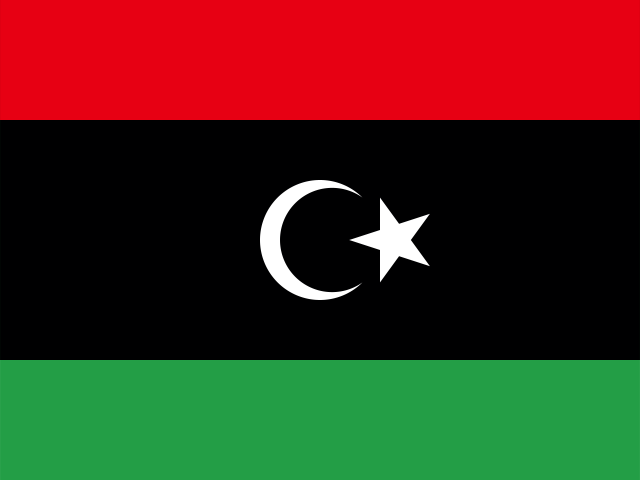
 Libya Gold Reserves
A hoard from the oil years
Libya’s gold reserve is large relative to the size of its population — a legacy of the long rule of Muammar Gaddafi, when the country’s abundant oil wealth funded the accumulation of substantial reserves, including gold. Gaddafi, who often framed his ambitions in pan-African and anti-Western terms, was reported to have taken a particular interest in gold, and at times mused about a gold-backed African currency to rival the dollar and the euro.
Whatever the truth of those ambitions, the result was a national gold holding of 147 tonnes — a considerable reserve for a country of Libya’s size, and a tangible store of the wealth that flowed from its oilfields during the decades of centralized rule. That hoard would outlast the regime that built it, and become entangled in the chaos that followed its fall.
A reserve in a divided state
Since the 2011 uprising and the killing of Gaddafi, Libya has been riven by conflict and political division, at times split between rival governments and competing institutions in the west and east of the country. In such a fractured state, control of the central bank — and of the gold and reserves it holds — becomes a strategic prize of the highest order.
The Central Bank of Libya has itself, at points, been divided, with rival branches and disputed leadership mirroring the country’s broader fragmentation. The national gold has accordingly been a recurring flashpoint: whoever controls it controls a vast, liquid store of value that confers both financial power and a claim to legitimacy. Libya’s reserve illustrates a darker truth about national gold — that in a collapsed or contested state, a hoard of the metal is not just wealth but a weapon and a trophy.
Gold as contested sovereignty
For Libya, the gold has come to symbolize the sovereignty the country has struggled to reconstitute. A unified, functioning state would hold and manage the reserve as a normal monetary asset; a divided one finds the same gold transformed into an object of rivalry, its control a measure of which faction can claim to speak for the nation.
This gives Libya’s 147 tonnes a significance out of proportion to their market value. They are a reminder that the institutions surrounding gold — a single recognized central bank, a stable government, the rule of law — are what allow a reserve to function as intended. Strip those away, and the metal remains, but its meaning changes: from a quiet anchor of monetary stability into a contested asset at the heart of a struggle for the state itself.
A holding awaiting a settled state
At roughly 20% of total reserves, gold is a meaningful component of Libya’s holdings, and the reserve has remained largely intact in tonnage terms through the years of turmoil — preserved, in part, precisely because rival factions have been unwilling to let one another spend it. In that uneasy stalemate, the gold endures.
Libya’s reserve, in the end, waits on the country’s politics. Should Libya one day achieve a durable settlement and a unified central bank, the 147 tonnes would resume their ordinary role as a stable foundation for the national balance sheet — a substantial reserve to underpin reconstruction. Until then, the gold sits as both an asset and an emblem: of the wealth Libya possesses, and of the functioning state it has yet to rebuild around it.
Where the gold is held
The Central Bank of Libya holds the national gold reserve, kept domestically. Control of the central bank — and therefore of the gold and the country’s broader reserves — has been a central point of contention in Libya’s long political division.
 Algeria
  Egypt
Egypt  South Africa
  Brazil