Specifications
French Napoleon (20 Francs) at a glance
Composition
- Alloy
- Gold (90%) + Copper (10%)
- Color
- Warm, slightly reddish 90% gold
- Thickness
- 1.3 mm
- Available weights
- 20 Francs, 40 / 10 / 5 Francs
Provenance
- Issuing mint
- Monnaie de Paris →
- Mint location
- Paris, France
- First minted
- 1803
- Face value
- 20 Francs (historic)
- Legal tender
- No
- IRA eligible (US)
- No
Source: issuing mint specifications, cross-checked against published dealer and grading-service data.
The story
History
The "Napoleon" is the popular name for the French 20-franc gold coin, first struck in 1803 under Napoleon Bonaparte. It became the backbone of French circulating gold and, through the Latin Monetary Union (1865), the template for an interchangeable European gold coinage — the Swiss 20 francs, Italian 20 lire, Belgian 20 francs and others all shared its exact weight and fineness.
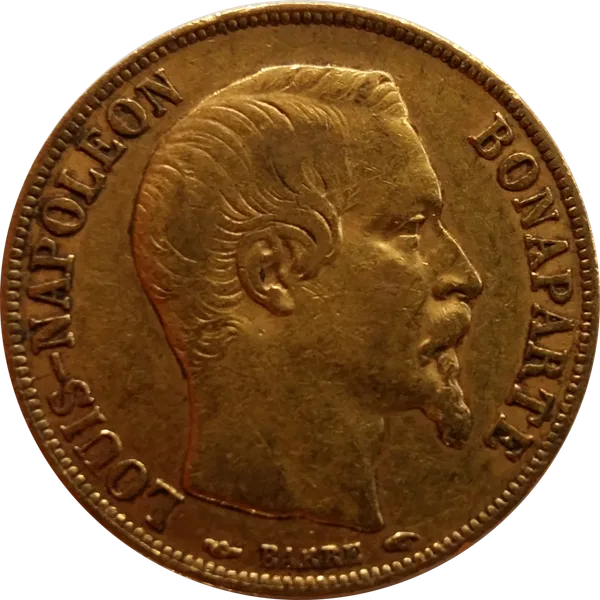
Over more than a century the obverse changed with France's turbulent politics: the laureate head of Napoleon I, then Napoleon III, then the Génie (Angel writing the constitution), the Cérès head, and finally the famous Rooster (Coq) of the Third Republic, struck until 1914.
Hundreds of millions were minted, so common-date Napoleons survive in enormous quantity. That abundance is exactly why they are prized today: they trade at some of the lowest premiums of any gold coin, in a small, recognizable, easily-traded format — the classic continental "survival" coin tucked away for hard times.
- 1803 — First 20-franc Napoleon under Bonaparte
- 1865 — Latin Monetary Union standardizes the format Europe-wide
- 1899–1914 — The famous "Rooster" (Coq) type
- Minted in vast numbers → very low premiums today
The two faces
Design
Varies by era: the laureate head of Napoleon I or III; the seated Génie writing the constitution; the Cérès (Ceres) head; or, most famously, Marianne in a Phrygian-style cap on the Rooster type.
Depending on type: a wreath and "20 FRANCS," the imperial arms, or the celebrated **Gallic rooster** with "LIBERTÉ ÉGALITÉ FRATERNITÉ" — the emblem of the French Republic.
Coin photography: Tradewater (original) and Prométhée (derivative work) (CC BY 3.0) — via Wikimedia Commons.
Authentication & counterfeit watch
How to spot a genuine French Napoleon (20 Francs)
A genuine 20-franc Napoleon weighs 6.45 g, measures 21 mm across and about 1.3 mm thick, containing 0.1867 oz of fine gold — specifications shared exactly with the Swiss Vreneli and other Latin Monetary Union 20-franc coins. It is non-magnetic. With such a precise, well-documented standard, a jeweller's scale and caliper are highly effective. Because the type and date combinations are well cataloged, a portrait that doesn't match its date — or a "rooster" coin dated outside 1899–1914 — is a fake. Edge lettering ("DIEU PROTÈGE LA FRANCE" on Rooster types) should be crisp.
Authentication guidance is general reference, not a substitute for professional verification. For high-value purchases, buy from reputable dealers and consider professional grading.
For the investor
Investment considerations
The Napoleon's appeal is simple: maximum gold, minimum premium, in a tiny, time-tested package. Because so many were struck, common-date coins trade very close to their melt value — ideal for cost-conscious accumulation of small increments.
It is not IRA-eligible (90% fine, historic). It is also no longer legal tender. But across Europe — especially France — the Napoleon is one of the most liquid coins in existence, bought and sold by every dealer at a tight spread.
These coins are bought for the gold, not the grade: unless a piece is genuinely scarce or in exceptional condition, value tracks the 0.1867 oz of gold it contains. Buy common dates by weight and don't overpay for "old."
Common questions
French Napoleon (20 Francs) FAQ
How much gold is in a 20-franc Napoleon?
Exactly 0.1867 troy oz (5.81 g) of fine gold, in a 6.45 g coin that is 90% gold — the same standard as the Swiss, Italian and Belgian 20-franc/lira coins.
Why are Napoleons so cheap to buy?
Hundreds of millions were minted, so common dates are abundant and trade at some of the lowest premiums over spot of any gold coin — popular for low-cost accumulation.
Are all "Napoleons" the same?
They share weight and fineness but vary in design across a century — Napoleon I and III, the Génie, Cérès, and the Republic’s Rooster. For bullion value they are interchangeable.
Can I put a Napoleon in a gold IRA?
No — at 90% purity it is below the IRA threshold and is a historic, non-legal-tender coin.