Specifications
Austrian Philharmonic at a glance
Composition
- Alloy
- Pure gold (99.99% fine)
- Color
- Warm, bright 24k gold with exceptional mirror-like fields
- Thickness
- 2.00 mm
- Available weights
- 1 oz, ½ oz, ¼ oz, 1/10 oz, 1/25 oz
Provenance
- Issuing mint
- Austrian Mint (Münze Österreich) →
- Mint location
- Vienna, Austria
- First minted
- 1989
- Face value
- €100 (1 oz), €50 (½ oz), €25 (¼ oz), €10 (1/10 oz), €4 (1/25 oz)
- Legal tender
- Yes
- IRA eligible (US)
- Yes
Source: issuing mint specifications, cross-checked against published dealer and grading-service data.
The story
History
The Vienna Philharmonic — known in English markets as the Gold Philharmonic — debuted in October 1989 as Europe's answer to the North American bullion coin phenomenon.
Austria's Münze Österreich (Vienna Mint) had a unique asset: the Vienna Philharmonic Orchestra, universally recognized as one of the world's greatest and a symbol of Austrian cultural excellence. Dedicating the coin to the Philharmonic gave it immediate prestige and a global cultural resonance that purely nationalistic coins lacked.
In 2002, when Austria adopted the euro, the Philharmonic became the world's first euro-denominated bullion coin. Its earlier issues (1989–2001) had been denominated in Austrian schillings. Through the 1990s it became the world's best-selling gold coin in multiple years — remarkable for a country of just 9 million. Germany, with a culturally ingrained preference for gold savings rooted in the Weimar hyperinflation, became its largest market.
The Vienna Mint has since produced Philharmonics in platinum, silver, and palladium, but the gold coin remains the flagship, produced annually without interruption since 1989.
- 1989 — First Vienna Philharmonic (Austrian schilling)
- 1990s — World’s best-selling gold coin in several years
- 2002 — Becomes the first euro-denominated bullion coin
- Today — Europe’s benchmark bullion coin, strongest in the German-speaking market
The two faces
Design
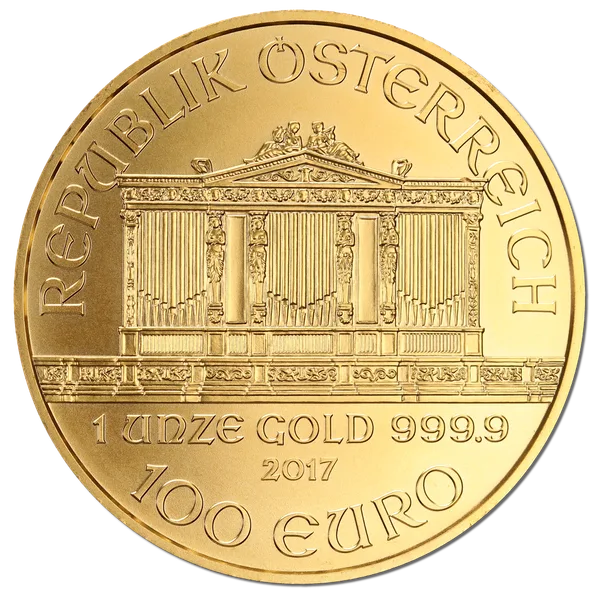
The Great Organ of the Vienna Musikverein (Golden Hall) — Austria's most prestigious concert venue and the Philharmonic's home stage. "REPUBLIK ÖSTERREICH" and the face value surround the design.
An assembly of Vienna Philharmonic instruments: a Vienna horn, four violins, a bassoon, a harp, and a cello, engraved with exceptional precision. "WIENER PHILHARMONIKER" and the gold specifications appear.
Coin photography: CoinInvest GmbH (CC BY-SA 4.0) — via Wikimedia Commons.
Authentication & counterfeit watch
How to spot a genuine Austrian Philharmonic
The Philharmonic has the most distinctive dimensions of any major 1 oz coin: at 37.00 mm it is the widest 1 oz bullion coin, and correspondingly the thinnest at 2.00 mm. That unusual wide-and-thin profile is itself a strong authenticity check — a fake struck from a standard ~32 mm blank simply will not match. It weighs 31.10 g (pure gold) and is non-magnetic. The mirror-like fields and the crisp pipes of the Musikverein organ should be sharp under magnification. As always, weigh and measure: matching the 37 mm width, 2 mm thickness, and 31.1 g mass simultaneously is very hard to fake.
Authentication guidance is general reference, not a substitute for professional verification. For high-value purchases, buy from reputable dealers and consider professional grading.
For the investor
Investment considerations
The Philharmonic is the dominant bullion coin in the German-speaking world and has strong demand across Europe. Its liquidity in European markets is unmatched — any continental dealer will buy and sell it without hesitation. It is IRA eligible under US rules.
European VAT: in the EU, gold investment coins including the Philharmonic are exempt from VAT — a significant advantage over other gold products.
Premiums typically run 3–5% for 1 oz bullion; the coin's very high mintage volumes keep premiums competitive.
Common questions
Austrian Philharmonic FAQ
Why is the Philharmonic so wide and thin?
It is the largest-diameter 1 oz bullion coin at 37 mm and only 2 mm thick. That distinctive profile makes it easy to recognize — and hard to counterfeit with standard blanks.
Is the Vienna Philharmonic IRA-eligible?
Yes. At 99.99% purity it qualifies for US self-directed gold IRAs, though it is held less often in the US than the Eagle or Maple Leaf.
Do I pay VAT on a Philharmonic in Europe?
No. Investment gold coins, including the Philharmonic, are VAT-exempt across the EU — a meaningful saving versus many other gold products.
Why is it so popular in Germany?
German savers have a deep, historically rooted preference for physical gold (a legacy of 1920s hyperinflation), and the Philharmonic is the region’s most recognized and liquid coin.