Specifications
American Gold Eagle at a glance
Composition
- Alloy
- Gold (91.67%) + Silver (3%) + Copper (5.33%)
- Color
- Rich warm gold (silver/copper alloy, slightly different from Krugerrand)
- Thickness
- 2.87 mm
- Available weights
- 1 oz, ½ oz, ¼ oz, 1/10 oz
Provenance
- Issuing mint
- United States Mint →
- Mint location
- West Point, New York (gold); Philadelphia, San Francisco (proofs)
- First minted
- 1986
- Face value
- $50 (1 oz), $25 (½ oz), $10 (¼ oz), $5 (1/10 oz)
- Legal tender
- Yes
- IRA eligible (US)
- Yes
Source: issuing mint specifications, cross-checked against published dealer and grading-service data.
The story
History
Congress authorized the American Gold Eagle in 1985 with the Gold Bullion Coin Act, responding to decades of American investors being locked out of gold coin ownership. Gold ownership had been illegal for most Americans from 1933 (FDR's Executive Order 6102) until 1974, when President Ford re-legalized private gold ownership. But with no official American coin, US investors were buying Krugerrands and Maple Leafs.
The Eagle debuted in October 1986 and was an immediate sensation — within weeks it had overtaken the Krugerrand as the best-selling bullion coin in America (aided, no doubt, by the Krugerrand sanctions that took effect in 1985). The US Mint had inadvertently timed the launch perfectly.
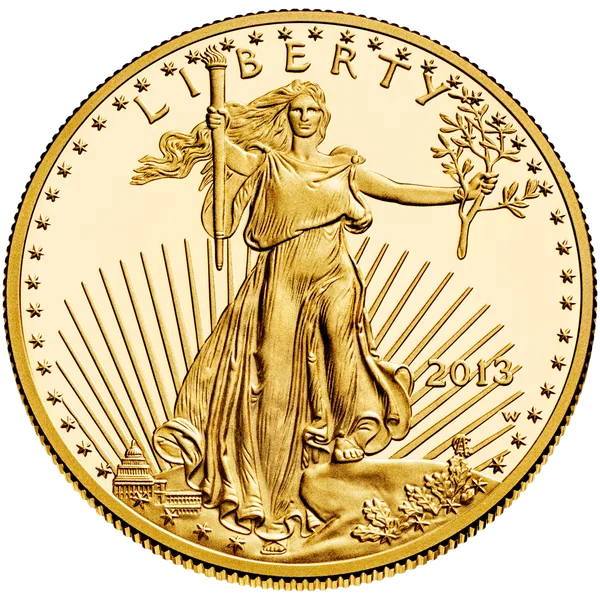
The design choice was inspired: the obverse is based on Augustus Saint-Gaudens' celebrated 1907 $20 "Double Eagle" gold coin — widely considered the most beautiful American coin ever made. The modern coin adapts that design faithfully, keeping the striding Lady Liberty with torch and olive branch; sculptor Miley Busiek contributed the original family-of-eagles reverse.
The Gold Eagle's alloy — 22 karat, like the Krugerrand — was chosen for durability, as the Mint worried that soft 24k gold would mark too easily. In 2021, the US Mint introduced a redesigned reverse — the first since 1986 — by artist Jennie Norris, depicting a close-up of a single eagle in flight, replacing the original family-of-eagles design.
- 1985 — Gold Bullion Coin Act passed
- 1986 — First Eagles minted; quickly the best-selling US bullion coin
- 1992 — Production briefly suspended amid a shortage
- 2021 — Reverse redesigned (Type 2 — eagle portrait)
The two faces
Design
Lady Liberty, torch aloft in her right hand and olive branch in her left, strides forward against a sunrise, the US Capitol dome behind her. The design derives from Saint-Gaudens' iconic 1907 Double Eagle. "LIBERTY" and the mint year appear on the coin.
Since 2021: a single bald eagle in close-up flight against a field of stars (Jennie Norris). Prior to 2021: a male eagle carries an olive branch to a nest sheltering a female eagle and hatchlings (Miley Busiek).
Coin photography: United States Mint (Public domain) — via Wikimedia Commons.
Authentication & counterfeit watch
How to spot a genuine American Gold Eagle
A genuine 1 oz Gold Eagle weighs 33.93 g, measures 32.70 mm across and 2.87 mm thick — like the Krugerrand it is heavier and thicker than a pure-gold ounce because of the silver-copper alloy. It is non-magnetic; any magnet attraction is a fail. The US Mint guarantees content, and modern fakes most often miss on the weight-plus-thickness combination or show mushy detail in Liberty's gown and the eagle's feathers. The reeded edge must be even and complete. Burnished and proof Eagles have a distinctly different finish from bullion strikes — be sure you're paying a bullion price for a bullion coin, not a proof premium for a bullion piece (or vice-versa).
Authentication guidance is general reference, not a substitute for professional verification. For high-value purchases, buy from reputable dealers and consider professional grading.
For the investor
Investment considerations
The Gold Eagle's IRA eligibility is a major practical advantage — it's one of the few gold coins approved for a self-directed IRA (along with the Buffalo, Maple Leaf, Philharmonic, and Britannia). For investors building retirement accounts, this matters enormously.
US government backing provides an additional layer of confidence. The Mint guarantees the gold content and weight of every Eagle. Premiums typically run slightly above the Krugerrand for bullion Eagles — roughly 3–6% for 1 oz coins — reflecting the brand premium of the official US coin.
The fractional Eagles (½ oz, ¼ oz, 1/10 oz) carry proportionally higher premiums per ounce but allow investors with smaller budgets to participate.
Common questions
American Gold Eagle FAQ
Is the American Gold Eagle 24-karat?
No, it is 22-karat (91.67% gold). If you want a 24-karat US coin, the American Gold Buffalo is the Mint’s pure-gold option.
Why is the Eagle 22-karat instead of pure gold?
Durability. The silver-and-copper alloy makes the coin harder and more scratch-resistant than soft 24k gold, a design choice carried over from classic US gold coinage.
Are American Gold Eagles IRA-eligible?
Yes. The Eagle is explicitly approved for self-directed gold IRAs by statute, despite being below the usual 99.5% purity threshold.
What is the difference between Type 1 and Type 2 Eagles?
The 2021 redesign changed the reverse from the "family of eagles" (Type 1, 1986–2021) to a close-up eagle portrait (Type 2, 2021–). Gold content and specs are unchanged.